




Impacted Teeth Treatment in Frisco, TX
Impacted Canines & Second Molars — Expert Orthodontic Management by Dr. Baharvand & Dr. Kang
📞 972.538.4343

Panoramic X-ray series showing bilateral impacted canines — treated with palatal expansion followed by surgical exposure and gold chain traction at Elate Orthodontics
Impacted Teeth — Frisco TX
When a Tooth Refuses to Erupt on Its Own, We Have a Plan for That
An impacted tooth is one that fails to erupt into its correct position in the dental arch — usually because it is blocked by another tooth, a cyst, dense bone, or simply has insufficient space to emerge. Left untreated, impacted teeth can damage adjacent roots, cause crowding, and in some cases lead to cyst formation or bone loss. Caught at the right time, most impacted teeth can be guided into proper alignment through a coordinated orthodontic and surgical approach.
At Elate Orthodontics, Dr. Kevin Baharvand and Dr. Julia Kang manage impacted canine and second molar cases with a level of clinical depth that comes from years of specialized orthodontic training and thousands of treated patients. We coordinate directly with oral surgeons for the surgical exposure component, ensuring a seamless, well-sequenced treatment plan from diagnosis to final alignment.
The Two Most Common Impaction Cases We Treat
Most Common
Impacted Canines (Upper Eye Teeth)
The maxillary canines — the upper “eye teeth” — are the second most commonly impacted teeth after wisdom teeth. They are also among the most important teeth in the mouth: canines have the longest roots of any tooth, anchor the corners of the smile, and play a critical role in guiding the bite. Losing a canine or leaving it impacted is not a minor matter.
Upper canines typically erupt around age 11 to 13. If they haven’t appeared by age 14, early evaluation is warranted. Palatal (roof-of-mouth) impactions are more common than labial (lip-side) ones and generally carry a better prognosis for successful orthodontic traction.
Less Known, Equally Important
Impacted Second Molars (Lower 7s)
Mandibular second molar impactions are less discussed than canine impactions but can be equally complex. The lower second molar (the tooth just in front of the wisdom tooth) sometimes becomes tipped or blocked during eruption — often due to pressure from an overlying wisdom tooth or simply insufficient arch space — and fails to erupt fully upright into the bite.
When caught early, tipped or impacted second molars can often be uprighted orthodontically, preserving the tooth and avoiding extraction. In select cases, we recommend early removal of the wisdom tooth (third molar) to relieve pressure and allow the second molar to self-correct or respond to orthodontic traction.
Canine Impaction Treatment
How We Treat Impacted Canines: The Full Sequence
Diagnosis & Imaging
Panoramic X-rays confirm the position of the impacted canine. In complex cases, we assess the exact labial or palatal location and proximity to adjacent roots. Early diagnosis — ideally before age 12 — dramatically improves treatment outcomes.
Space Creation
Before traction can begin, sufficient space must exist in the arch for the canine to erupt into. For palatal impactions, a palatal expander is often used to widen the upper arch and create the room needed. Baby teeth (primary canines) may also be extracted to remove obstructions and encourage eruption.
Surgical Exposure
An oral surgeon uncovers the impacted canine by removing the gum tissue overlying it. At the same appointment, a small gold chain or bracket is bonded directly to the tooth. The gum tissue is then repositioned, leaving the chain accessible for orthodontic traction to begin.
Orthodontic Traction
Using the gold chain bonded to the exposed tooth, we apply gentle, controlled forces through the braces to slowly guide the canine into its correct position in the arch. This process typically takes 12 to 18 months depending on the starting position of the tooth and the patient’s growth stage.
Final Alignment
Once the canine is in the arch, full orthodontic treatment continues to align all teeth into their ideal positions. The canine is finished like any other tooth — fitting naturally into the bite and smile. The result is a complete, stable, fully functional dentition.
Real Patient Case
Bilateral Impacted Canines — Before & After
The panoramic series shown here illustrates a patient with bilateral maxillary canine impactions — both upper canines trapped above the roots of the lateral incisors. The orange arrows mark the canine positions on the pre-treatment film.
Treatment began with palatal expansion to create arch space, followed by surgical exposure and gold chain attachment by our coordinating oral surgeon. Orthodontic traction then guided both canines down and into their correct positions in the arch simultaneously.
Cases like this are a clinical specialty at Elate Orthodontics. The coordination between orthodontic mechanics and surgical timing is what determines the outcome — and it requires an orthodontist who has managed this sequence many times before.
Panoramic series: bilateral impacted canines before and after orthodontic traction with gold chain
Second Molar Impaction
Uprighting Impacted Second Molars
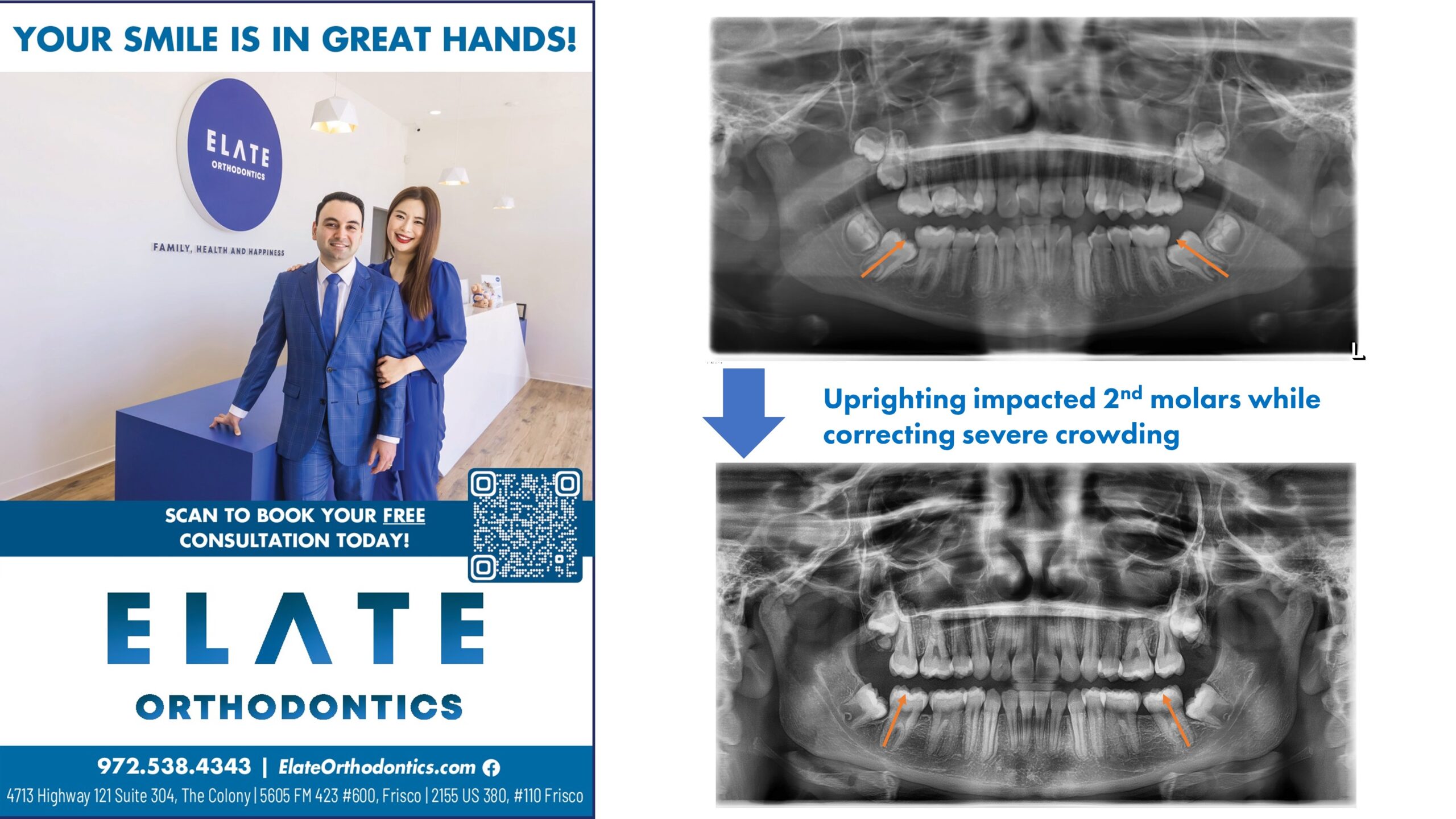
Mandibular second molars sometimes become tipped or partially impacted during eruption — often blocked by the erupting wisdom tooth behind them. The result is a tooth that is tilted mesially (forward) into the first molar, sometimes with the crown partially submerged under gum tissue. Without intervention, a tipped second molar can cause decay, periodontal pocketing, and eventual loss of adjacent teeth.
When We Recommend Early Wisdom Tooth Removal
In many second molar impaction cases, the overlying wisdom tooth (third molar) is the primary obstruction. When this is the case, we coordinate with an oral surgeon for early wisdom tooth removal — creating the space needed for the second molar to either self-correct or respond to orthodontic uprighting forces. Timing matters: the earlier this is done, the better the second molar’s eruption potential.
Orthodontic Uprighting
When the second molar is tipped but not fully impacted, orthodontic mechanics can upright the tooth without surgery. Using TADs (temporary anchorage devices) or specialized springs, we apply controlled forces to rotate the second molar to an upright position and bring it into full function in the bite. This is one of the more technically demanding orthodontic movements — and one of the most rewarding when it succeeds.
Surgical Exposure for Second Molars
In fully impacted second molar cases where the tooth is submerged below the gumline, surgical exposure followed by orthodontic traction — similar to the canine impaction approach — may be required. We assess each case individually and recommend the most conservative effective approach that preserves the tooth and the surrounding bone.
Why Timing Is Everything
The single most important factor in impaction treatment outcomes is how early the condition is identified. A canine impaction detected at age 10 or 11 — before root formation is complete and while the jaw is still growing — responds dramatically better to treatment than the same impaction identified at 16 or 18. The tooth moves more readily, the surrounding bone is more responsive, and the risk of root resorption to adjacent teeth is lower.
This is why the American Association of Orthodontists recommends every child have an orthodontic evaluation by age 7. We are not looking to start treatment at 7 — we are looking for early signs of impaction, crowding, and skeletal discrepancy that are far easier to manage when identified early.
What Happens If an Impaction Is Left Untreated
Root resorption of adjacent teeth — the impacted tooth’s pressure can dissolve the roots of neighboring teeth
Cyst formation around the crown of the impacted tooth, causing bone destruction
Progressive crowding as the impacted tooth shifts and displaces neighboring teeth
Eventual need for extraction — a canine replaced by an implant or bridge is never as ideal as a natural tooth in its correct position
For second molars: decay and bone loss from the tipped tooth trapping food and bacteria against the adjacent first molar
Common Questions
Impacted Tooth FAQ
How do I know if my child has an impacted canine?
Often there are no obvious symptoms until damage to adjacent teeth has already begun. The most reliable indicator is that the baby canine is still present past age 13 or 14 with no sign of the adult canine erupting. A panoramic X-ray taken during an orthodontic evaluation will reveal the position of all unerupted teeth — this is one of the most important reasons for the age-7 evaluation recommendation.
Does the surgical exposure hurt?
The procedure is performed under local anesthesia and is well-tolerated by most patients. There is typically some soreness for a few days afterward, managed with over-the-counter pain medication. The vast majority of patients — including teenagers — find it much more manageable than they expected. The oral surgeon we coordinate with performs this procedure routinely.
Can an impacted canine always be saved?
In most cases, yes — especially when identified early. Exceptions include cases where the tooth is severely ankylosed (fused to the bone), where root resorption of adjacent teeth is already advanced, or where the impaction position is extremely unfavorable. We evaluate each case honestly and will tell you when traction is likely to succeed and when extraction followed by an implant or space closure is the more realistic path.
How long does canine impaction treatment take?
Total treatment time — from the start of orthodontic preparation through full alignment — is typically 18 to 30 months depending on the starting position of the tooth, patient age, and how much of the overall treatment involves general alignment. The traction phase alone (moving the canine into the arch) usually takes 12 to 18 months after surgical exposure.
What is a gold chain in orthodontics?
A gold chain is a small, flexible ligature chain bonded to the impacted tooth at the time of surgical exposure. It serves as an attachment point for the orthodontic traction force — essentially a handle on a tooth that is otherwise completely inaccessible to orthodontic mechanics. The chain is tied to the braces wire and gradually shortened over time to pull the tooth into position.
Should my child’s wisdom teeth come out to help an impacted second molar?
In many cases, yes. When a wisdom tooth is directly blocking the eruption path of a tipped second molar, early removal of the wisdom tooth can allow the second molar to self-correct or makes orthodontic uprighting significantly more effective. The decision depends on the specific anatomy of the case — we evaluate this on panoramic films at your consultation and give you a clear recommendation.
Why Families Choose Elate Orthodontics for Impaction Cases
Impaction cases require a higher level of orthodontic planning than routine alignment. The sequencing of expansion, surgical exposure, and traction — and the communication between the orthodontist and the oral surgeon — directly determines the outcome. Dr. Baharvand and Dr. Kang have managed many canine and second molar impaction cases and understand the mechanics, the timing, and the nuances that make the difference between a tooth that makes it into the arch and one that doesn’t.
Elate Orthodontics is an ABO board-certified practice led by a published orthodontist whose work has appeared in the American Journal of Orthodontics and Dentofacial Orthopedics. When you bring a complex impaction case here, you are bringing it to doctors who have seen and treated cases like yours — and who will give you an honest assessment of what is possible.
1,000+
Five-star reviews across 3 locations
ABO
Board-certified orthodontist
Published
AJO-DO cover clinician
Free
Initial consultation with X-ray review
Our Locations
West Frisco
5605 FM 423, Suite 600
Frisco, TX 75036
FM 423 & Lebanon Rd — next to the UPS Store
The Colony
4713 Highway 121, Suite 304
The Colony, TX 75056
FM 423 & Hwy 121 — next to Ross
North Frisco
2155 University Dr, Suite 110
Frisco, TX 75033
On 380 across from Cook Children’s Medical Center Prosper
Hours: Mon–Fri 8:00am–5:00pm | 972.538.4343
Concerned About an Impacted Tooth? Let’s Take a Look.
Free consultations available at all three Elate Orthodontics locations. We review your X-rays, assess the impaction, and give you an honest treatment plan and timeline. No pressure, no surprises.
Also see: All Treatments | Meet Dr. B & Dr. Kang | Tribute Family Dentistry