


7 min read • By Dr. Kevin Baharvand, Diplomate, American Board of Orthodontics
SHORT ANSWER
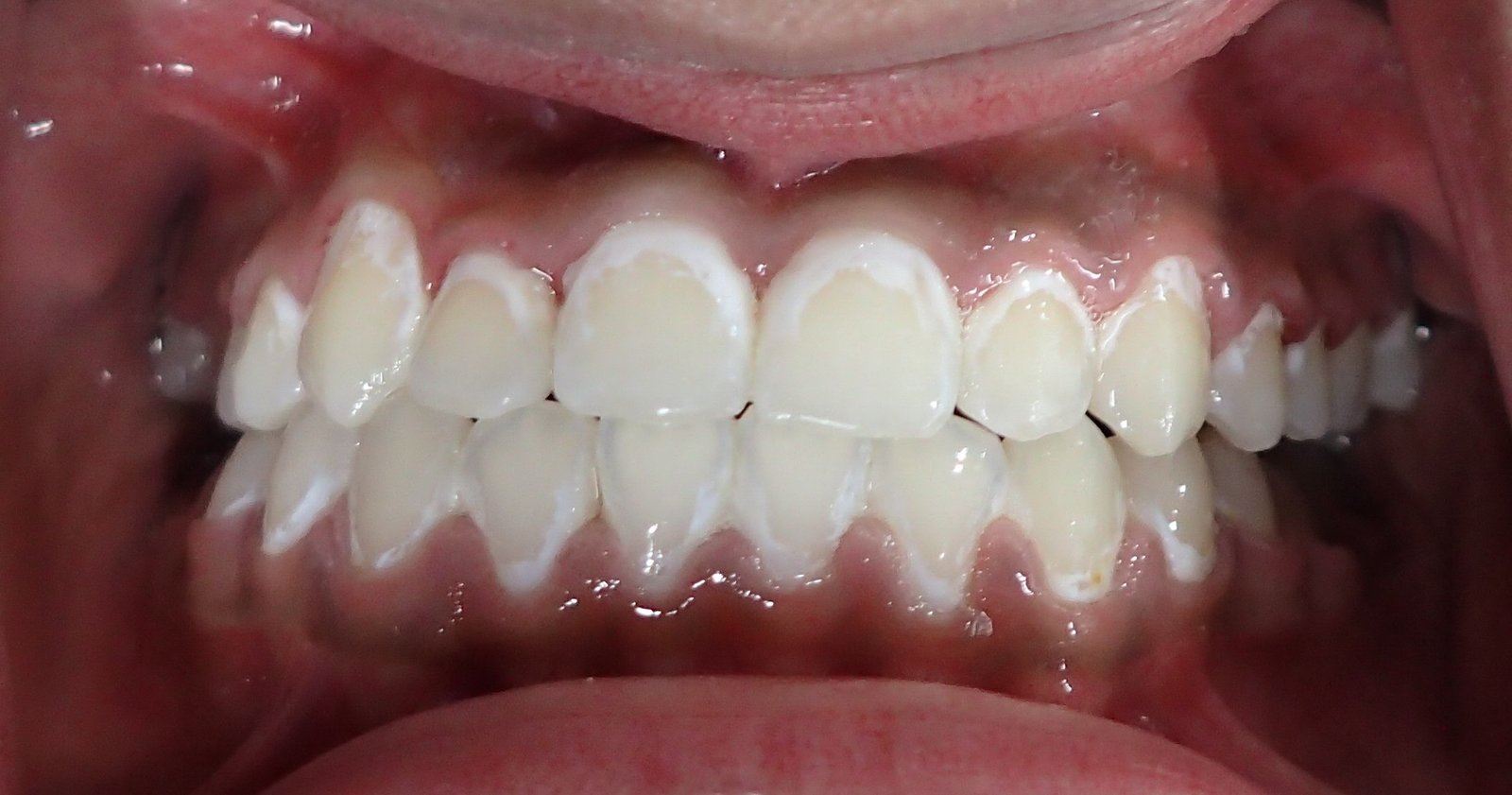
Those chalky white marks are decalcification, the stage right before a cavity. Plaque sitting against enamel around a bracket produces acid, the enamel loses mineral, and what is left scatters light differently than healthy enamel. Early spots often improve substantially with fluoride and remineralization. Deeper ones need resin infiltration, microabrasion, or bonding. Almost all of it is preventable, and the prevention is unglamorous: clean around every bracket, every day.
ON THIS PAGE
Why the spots show up when the braces come off
Debond day is supposed to be the good day. Then the brackets come off and there is a pale square outline where each one used to sit. It is deflating, and the timing is cruel, because the damage did not happen that morning. It happened slowly over months underneath the bracket you could see but not reach.
The clinical name is a white spot lesion, or decalcification. Plaque collects at the edge of a bracket, the bacteria in it produce acid after you eat, and that acid pulls calcium and phosphate out of the enamel surface. Healthy enamel is dense and translucent. Demineralized enamel is porous, so it scatters light instead of transmitting it, and that is what you are seeing. The spot is not something added to the tooth. It is mineral that left.
It develops faster than most people assume. Visible decalcification can begin within about four weeks around a bracket that is not getting cleaned well. That is the honest reason we bring up brushing at every single appointment and why it can feel repetitive.
Are they permanent?
Mostly the answer is no, but with a caveat worth understanding. The lesion has depth. A shallow one, caught early, can remineralize enough that you stop noticing it in normal light. A deep one has lost structure below the surface, and no amount of fluoride is going to rebuild that. Those need something that fills or removes the porous layer.
Do not judge the final appearance in the first month after debond. Teeth dehydrate slightly under brackets and during the appointment, which makes white spots look considerably worse than they will look in a few weeks once everything rehydrates. So the mirror on debond day is not showing you the final result.
Give it three to six months of good home care and fluoride before deciding whether you want a procedure. A meaningful number of patients decide they no longer care.
How to not get them in the first place
Prevention is not complicated, it is just relentless. The list below is roughly in order of how much difference each item actually makes.
| What to do | Why it matters |
|---|---|
| Brush after every meal, angled at the bracket edge | The gum-side edge of the bracket is where nearly every lesion starts. Aim the bristles there at 45 degrees, not straight on. |
| Use a high-fluoride toothpaste | Prescription-strength 5,000 ppm paste is far more protective than standard. Ask us for it if you are high risk. |
| Cut the sipping, not just the sweets | A soda over two hours is worse than one drunk in ten minutes. Frequency of acid exposure matters more than total quantity. |
| Water flosser or interdental brush | Not a replacement for brushing, but it reaches around wires far better than string floss for most people. |
| Keep your regular dental cleanings | Every six months during treatment, not paused until braces come off. This is the one people skip. |
If you want the full routine, our guide to cleanings during braces covers the appointment side of this.
Treatment options, weakest to strongest
Fluoride and remineralization
First line, and it costs almost nothing. Prescription fluoride paste at home, in-office varnish, sometimes a calcium phosphate paste. This pulls mineral back into the surface layer over months, not days. Best results on recent, shallow spots.
Microabrasion
A mild acid and abrasive compound is used to polish away a very thin layer of the porous surface. Good for superficial spots. It does remove a small amount of enamel permanently, so it is not something to repeat casually.
Resin infiltration
This is the one that changed how we handle moderate cases. A low-viscosity resin wicks into the porous lesion and fills it, so light passes through it the way it passes through healthy enamel. The spot largely disappears rather than being covered up. No drilling, usually one visit. It works best on lesions that are not too deep, which is another argument for dealing with this sooner.
Whitening
Useful, but as a finishing step rather than a fix. It lightens the surrounding enamel so there is less contrast with the spot. See the warning below about sequence.
Bonding or veneers
Last resort, for spots that are deep or extensive enough that nothing else gets you where you want to be. It works reliably, but you are committing that tooth to restorative maintenance for life. I would exhaust everything above first, and I say that as someone who could just as easily refer you for it.
Why whitening first backfires
This is the most common mistake, and it is an understandable one. The spots are white, so whitening the rest of the tooth ought to even things out. In practice, porous enamel takes up peroxide faster than healthy enamel does, so the spots brighten first and the contrast gets worse before it gets better.
Order matters: remineralize first, treat the lesions if needed, then whiten. Wait a few months after debond before any bleaching. Doing it in the reverse order is why some people think their spots got worse after treatment.
Frequently asked questions
Are white spots after braces permanent?
The lesion itself does not simply disappear, but the appearance often improves a lot. Early, shallow spots respond well to fluoride and remineralization over several months. Deeper ones need resin infiltration, microabrasion, or bonding. Very few cases are stuck as they are.
Do white spots mean I have a cavity?
They mean the enamel has lost mineral, which is the stage right before a cavity. Caught here it is reversible in a way an actual cavity is not. That is the good news buried in a frustrating problem.
Will whitening my teeth make the spots blend in?
Often it makes them more obvious at first, because the spots take up bleach differently than the surrounding enamel. If we whiten, we do it after remineralization and usually wait a few months post-braces. Whitening first is the most common mistake I see.
Can white spots appear under clear aligners too?
Much less often, because you take the trays out to eat and can brush normally. It still happens if someone drinks sugary or acidic drinks with the trays in, which traps that liquid against enamel for hours. This is the real reason we say water only with aligners in.
How long does it take for a white spot to form?
Faster than people expect. Visible decalcification can start in about four weeks around a bracket that is not being cleaned properly. That is why we bring it up at every appointment rather than at the end.
Whose fault is it if I get white spots?
Usually nobody is being careless on purpose. Brackets make cleaning genuinely harder and some people have enamel that demineralizes more easily. What matters is catching it early, which is what the check at every visit is for.
Worried about spots you can already see?
Bring them in. Early lesions have the most options, and the consultation is free. Two Frisco offices plus The Colony.
You may also be interested in these
- Swollen Gums With Braces: What Is Normal and What Is Not
- Can You Get Your Teeth Cleaned With Braces?
- Water Flossing: Is It Effective for Oral Care?
Why families trust Elate Orthodontics
1,000+ five-star reviews • 3 offices (two in Frisco, one in The Colony) • D Magazine Best Dentist 2026 • Living Magazine Readers’ Choice 2026
With over 1,000 five-star reviews across three locations, Elate Orthodontics is led by Dr. Kevin Baharvand, DMD, MS, a Diplomate of the American Board of Orthodontics, whose clinical work was recently selected for the cover of the American Journal of Orthodontics and Dentofacial Orthopedics, the most prestigious peer-reviewed journal in the field, and a national speaker on clear aligner treatment. Alongside Dr. Julia Kang, DMD, MS, both Boston University graduates and members of the Omicron Kappa Upsilon national honor society, our husband-and-wife team has been recognized as D Magazine Best Dentist 2026, Living Magazine Readers’ Choice 2026 Best Orthodontist in Frisco & Plano, Readers’ Choice Best Orthodontist in The Colony, Best New Business by the Chamber of Commerce, Nextdoor Neighborhood Favorite, and featured in Orthotown and Authority Magazine.
We serve families through three convenient offices in West Frisco, North Frisco, and The Colony, each staffed by the same trusted team, equipped with advanced technology, and committed to the personalized approach that consistently helps patients finish treatment sooner than expected. From braces and clear braces to Angel Aligners, we offer treatment for every age and every stage of life. We stay in-network with most insurance plans and offer flexible financing to make exceptional orthodontic care accessible for every family we serve.
Need general and family dentistry too? Our sister practice, Tribute Family Dentistry, provides dental care for all ages.
Book a free consultation: 972.538.4343
About the author
Dr. Kevin Baharvand, DMD, MS, is a Diplomate of the American Board of Orthodontics and a national speaker on clear aligner treatment. He practices at Elate Orthodontics in West Frisco, North Frisco, and The Colony, Texas.