

5 min read • By Dr. Kevin Baharvand, Diplomate, American Board of Orthodontics • Treatments & Appliances
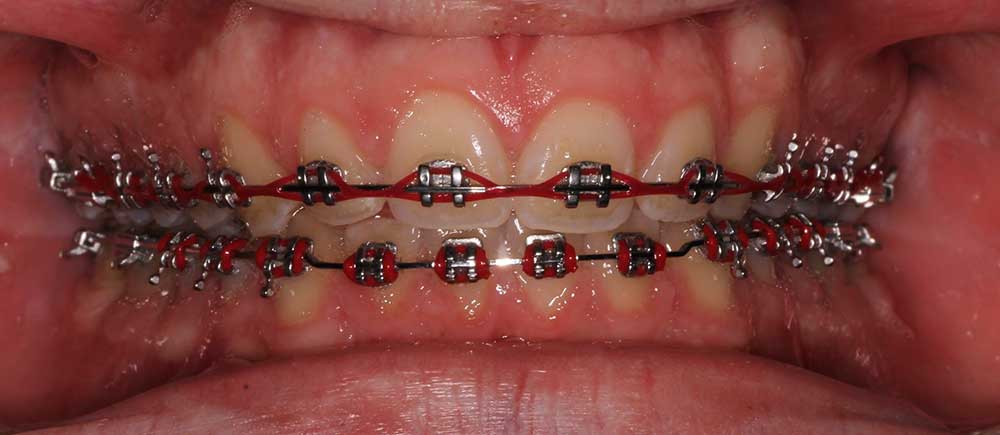
If your orthodontist mentioned adding a power chain, or you noticed your braces suddenly have a connected stretch of colored elastic instead of individual rings, you are looking at one of the handier tools in braces treatment. Power chains are how we close stubborn gaps and pull teeth neatly together, usually toward the back half of treatment. Here is what they are, why we use them, and what to expect while you have one.
What a power chain is
On regular braces, each bracket is usually held to the wire by its own small elastic ring. A power chain replaces those separate rings with one connected chain of elastic loops that links several teeth together. Because the loops are stretched and tied across multiple brackets at once, the chain pulls those teeth toward each other with continuous, gentle force. Think of it as trading a row of individual rubber bands for one linked band doing coordinated work.
What power chains do
Their main job is closing space. That might be a gap between teeth, the space left after a tooth was removed to relieve crowding, or small openings that appear as teeth shift during treatment. Power chains consolidate those spaces and tidy up alignment, which is why they so often show up in the later stages when we are fine-tuning your bite and closing the last of the gaps.
When we use them in treatment
You will not usually get a power chain on day one. Early in treatment we are focused on leveling and aligning the teeth. Once things are straighter and it is time to bring teeth together or close spaces, that is when a chain comes in. From there we may keep it on and replace it at each visit until the spaces are gone. Every case is different, so the timing and how long you wear one depends on your specific plan.
Do power chains hurt?
They add a little extra force, so it is normal to feel more pressure or tenderness for a day or two after one is placed or tightened, similar to the soreness after a routine adjustment. It is mild, temporary, and easily managed with an over-the-counter pain reliever and soft foods for a day. Within a couple of days most people forget it is there.
Colors and caring for them
Good news for the color fans: power chains come in the same wide range of colors as regular bands, so kids and teens can still personalize their look at every visit. Care is the same as with braces, with one note: clear or light-colored chains can pick up stain from coffee, curry, and similar foods, so darker shades hide it better if that is a concern. Keep up with brushing, avoid hard and sticky foods that could stretch or snap the chain, and it will do its job.
Frequently asked questions
Questions about your treatment?
We explain every step as we go. Book a free consultation and ask us anything.
You may also be interested in these
Why families trust Elate Orthodontics
With over 1,000 five-star reviews across three locations, Elate Orthodontics is led by Dr. Kevin Baharvand, DMD, MS, a Diplomate of the American Board of Orthodontics, whose clinical work was recently selected for the cover of the American Journal of Orthodontics and Dentofacial Orthopedics, the most prestigious peer-reviewed journal in the field, and a national speaker on clear aligner treatment. Alongside Dr. Julia Kang, DMD, MS, both Boston University graduates and members of the Omicron Kappa Upsilon national honor society, our husband-and-wife team has been recognized as D Magazine Best Dentist 2026, Living Magazine Readers’ Choice 2026 Best Orthodontist in Frisco & Plano, Readers’ Choice Best Orthodontist in The Colony, Best New Business by the Chamber of Commerce, Nextdoor Neighborhood Favorite, and featured in Orthotown and Authority Magazine.
We serve families through three convenient offices in West Frisco, North Frisco, and The Colony, each staffed by the same trusted team, equipped with advanced technology, and committed to the personalized approach that consistently helps patients finish treatment sooner than expected. From braces and clear braces to Angel Aligners, we offer treatment for every age and every stage of life. We stay in-network with most insurance plans and offer flexible financing to make exceptional orthodontic care accessible for every family we serve.
Need general and family dentistry too? Our sister practice, Tribute Family Dentistry, provides dental care for all ages.