


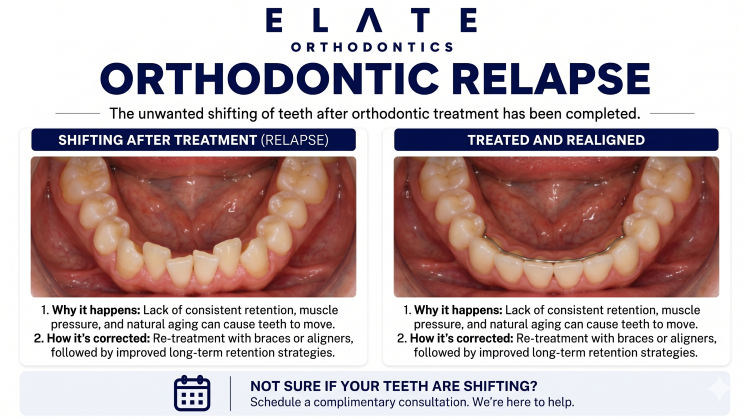
Teeth move. That’s usually the first thing I tell someone who comes in worried that their smile doesn’t look the way it did the day their braces came off. They move a little every day, whether you’ve had orthodontic treatment or not. Chewing, clenching, the pressure from your lips and tongue, normal aging. All of it nudges teeth around. I went through those causes in more detail in why teeth shift with age.
A retainer doesn’t stop that. What it does is push the teeth back where they belong each time you put it in. That distinction matters, because it explains both why retainers work so well and why they sometimes stop working.
Do teeth shift even if you wear your retainer?
Yes, a little. During the day, with the retainer out, teeth drift a tiny amount. At night, the retainer guides them back. It’s a small back-and-forth that happens every day, and for most people it’s invisible.
This is why a retainer can feel snug when you first put it in and comfortable a few minutes later. Snug is fine. It means the retainer is doing its job.
How much shifting can a retainer actually fix?
Less than most people assume. A clear retainer works a lot like a single aligner tray. In our experience, it can bring a tooth back roughly 0.2 mm in a straight line, or undo about 2.5 degrees of rotation. That’s about it.
For scale, 0.2 mm is about the thickness of two sheets of printer paper. So the retainer has a very small window to work with. Inside that window, it pushes teeth back into place night after night. Once a tooth moves or turns past it, the plastic can’t grip the tooth the right way anymore, and the retainer can no longer correct it.
What happens when teeth move past that point?
The retainer stops correcting and just sits there. Sometimes it won’t go in at all. Sometimes it goes in but rocks, leaves a visible gap along the edge, or presses hard on one tooth every single time.
Please don’t bite a retainer into place or force it down. It can crack, and forcing it doesn’t bring the teeth back. Give us a call instead. When teeth have moved beyond what a retainer can handle, getting them back usually means a short round of active treatment, and then new retainers made for the corrected position.
“But I wear it every night”
This is one of the most common conversations we have. A patient tells us they wear their retainers every night, and yet a front tooth has turned noticeably or a gap has opened up.
The numbers don’t really allow for that. If a retainer goes in every night, teeth don’t get the chance to wander far, because the retainer resets them before the movement adds up. So when we see a big shift, it almost always means the retainer hasn’t been in consistently, usually for a while.
We’re not saying that to scold anyone. Life happens. A retainer gets lost in a move, college starts, or a couple of skipped nights quietly turn into a couple of months. We’d just rather know, because the right fix depends on how long it’s been and how much has changed.
That said, there are real exceptions, and we check for them before assuming anything:
- The retainer no longer fits. Clear retainers warp if they’re left in a hot car or run through the dishwasher, and they wear thin or crack over a few years. A retainer that doesn’t fit can’t hold anything.
- New dental work. A crown, veneer, or large filling changes the shape of the tooth, and the old retainer may not fit it anymore.
- A loose bonded retainer. The wire behind the lower front teeth can come unglued from one tooth without you noticing. The wire looks fine, but that tooth is free to move.
- Missing teeth or gum changes. An extraction nearby or changes in the gums and bone can let teeth drift in ways a retainer wasn’t designed to hold.
How to tell if your retainer still fits
A retainer that fits should seat evenly with light finger pressure. Feeling tight for a few minutes and then settling in is normal. If it won’t seat all the way, rocks when you press on it, shows a gap between the plastic and your teeth, or makes the same tooth sore every time, that’s worth a visit.
And don’t wait on it. A few weeks can be the difference between a retainer that still catches the teeth and one that doesn’t.
What we do when teeth have shifted too far
We start with a digital scan and compare it to your records from the end of treatment. That shows exactly which teeth moved and by how much, which is more useful than anyone’s memory of what things used to look like.
For minor relapse, a short series of clear aligners often gets things back, followed by a new set of retainers. We use Angel Aligners for most of these cases. Some patients also do well with a bonded retainer behind the lower front teeth, which works whether or not you remember it at night. Larger changes may need a more involved round of treatment. Every case is evaluated in person before we recommend anything.
How long should you wear retainers?
Nightly, for as long as you want your teeth to stay where they are. There’s no age when teeth stop moving, so there’s no point where retainers stop being useful. Most people find that once it’s part of the bedtime routine, it stops feeling like a chore.
Common questions about teeth shifting with retainers
Can I wear my retainer more to push my teeth back?
If the retainer still seats completely and the shift is small, extra wear time can help. If it doesn’t seat, more hours won’t fix it. Call us before trying this so we can check the fit first.
Is it normal for my retainer to feel tight?
A little tightness when it first goes in is normal, especially after a missed night. Tightness that doesn’t ease up, or a retainer that won’t go all the way in, is a sign to come in.
I lost or broke my retainer. What now?
Call us as soon as you can. A new retainer is made from a fresh scan, and the sooner we scan, the closer your teeth still are to where they finished.
Do permanent retainers stop teeth from shifting?
They hold the teeth they’re bonded to, which is why they’re popular for lower front teeth. But they can come loose from one tooth without any pain, so we check them at every visit.
About the author
Dr. Kevin Baharvand, DMD, MS, is a board-certified orthodontist (Diplomate of the American Board of Orthodontics) and co-founder of Elate Orthodontics. He serves on the Orthotown editorial board and lectures nationally on clear aligner treatment.
Retainer checks in Frisco and The Colony
If your retainer doesn’t fit the way it used to, bring it with you and we’ll take a look. Call 972.538.4343 to schedule at any of our three offices.
Elate Orthodontics, West Frisco
5605 FM 423, Suite 600, Frisco, TX 75036
Elate Orthodontics, North Frisco
2155 University Dr, Suite 110, Frisco, TX 75033
Elate Orthodontics, The Colony
4713 Hwy 121, Suite 304, The Colony, TX 75056
Tribute Family Dentistry (sister practice)
5605 FM 423, Suite 600-B, Frisco, TX 75036
Getting a crown, veneer, or filling on a tooth that has a retainer over it? Our sister practice, Tribute Family Dentistry, is next door to our West Frisco office. Let us know before the work is done so we can plan for a retainer that fits the new tooth.