

Bite & Alignment Issues
6 min read • By Dr. Kevin Baharvand, Diplomate, American Board of Orthodontics
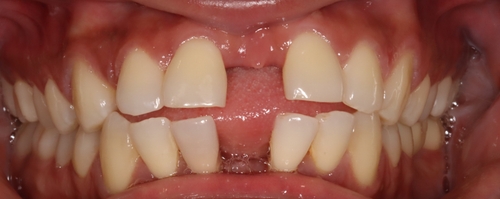
A gap between the front teeth, what dentists call a diastema, is one of those things people either love or want gone. Some wear it as a signature. Others would rather close it. Either choice is fine, but it helps to know why the gap is there in the first place, because the cause shapes how we'd fix it. Let me walk you through what creates gaps and the real options for closing them.
What are gaps in teeth?
A gap is simply a visible space between two teeth. The most common one sits between the upper front teeth, but gaps can appear anywhere in the arch. They're the opposite of crowding: instead of too little room, there's extra space the teeth aren't filling. You can learn more on our gapped teeth page.
What causes gaps between teeth?
- Teeth that are small for the jaw, leaving space between them.
- Missing teeth, which let neighbors drift apart into the empty space.
- An oversized labial frenum, the band of tissue between your upper lip and gums, which can wedge the front teeth apart.
- Habits like thumb-sucking or tongue thrusting that push teeth forward over time.
- Gum disease, which can loosen teeth and let them shift and separate.
Do gaps need to be fixed?
Many gaps are purely cosmetic, and if yours doesn't bother you, there's no medical rule saying it must go. That said, gaps can trap food, and a gap caused by a missing tooth or gum disease points to an underlying issue that deserves attention. The tie-in with the frenum or a tongue-thrust habit also matters, because if we close a gap without addressing the cause, it can drift back open. That's where a proper evaluation earns its keep.
How gaps are closed
| Cause / situation | Typical fix |
|---|---|
| Simple spacing | Braces or clear aligners to close the gap |
| Oversized frenum | A minor frenectomy, then orthodontics |
| Missing tooth | Orthodontics to manage space, plus an implant or bridge |
| After closing | A retainer to hold the result |
For most people, braces or clear aligners glide the teeth together over a few months, often with a power chain to help close the space. If a frenum or a habit is driving the gap, we address that as part of the plan so it stays closed. And because teeth like to drift back toward old positions, wearing your retainer afterward is non-negotiable, it's what makes the result last.
Thinking about closing a gap?
A free consultation covers the cause and the best way to close it for good.
Frequently asked questions
You may also be interested in these
Why families trust Elate Orthodontics
With over 1,000 five-star reviews across three locations, Elate Orthodontics is led by Dr. Kevin Baharvand, DMD, MS, a Diplomate of the American Board of Orthodontics, whose clinical work was recently selected for the cover of the American Journal of Orthodontics and Dentofacial Orthopedics, the most prestigious peer-reviewed journal in the field, and a national speaker on clear aligner treatment. Alongside Dr. Julia Kang, DMD, MS, both Boston University graduates and members of the Omicron Kappa Upsilon national honor society, our husband-and-wife team has been recognized as D Magazine Best Dentist 2026, Living Magazine Readers' Choice 2026 Best Orthodontist in Frisco & Plano, Readers' Choice Best Orthodontist in The Colony, Best New Business by the Chamber of Commerce, Nextdoor Neighborhood Favorite, and featured in Orthotown and Authority Magazine.
We serve families through three convenient offices in West Frisco, North Frisco, and The Colony, each staffed by the same trusted team, equipped with advanced technology, and committed to the personalized approach that consistently helps patients finish treatment sooner than expected. From braces and clear braces to Angel Aligners, we offer treatment for every age and every stage of life. We stay in-network with most insurance plans and offer flexible financing to make exceptional orthodontic care accessible for every family we serve.
Need general and family dentistry too? Our sister practice, Tribute Family Dentistry, provides dental care for all ages.