


7 min read • By Dr. Kevin Baharvand, Diplomate, American Board of Orthodontics
SHORT ANSWER
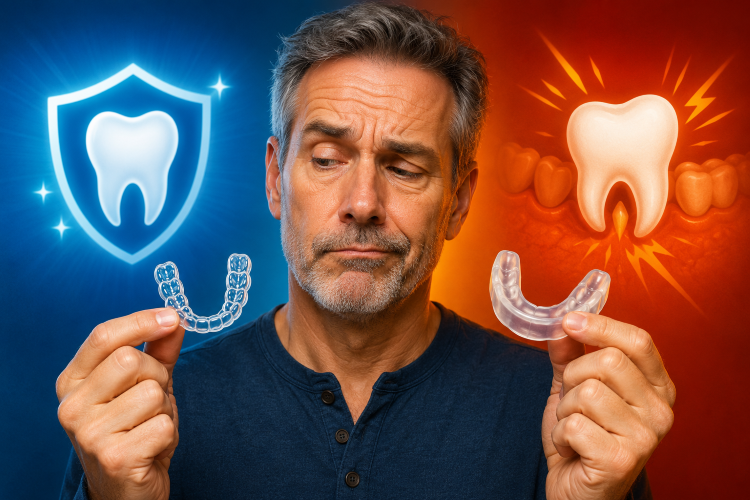
Yes, but not stacked on top of each other. They do different jobs. A retainer holds tooth position, a night guard absorbs grinding force, and a retainer is far too thin to survive being used as a guard. Realistic options are one on each arch, alternating on a schedule we set, or a single appliance fabricated thick enough to do both. Which one is right depends on how heavily you grind and where.
ON THIS PAGE
Two appliances, two different jobs
This question comes up constantly, usually from someone who finished braces, was given a retainer, and then found out from their dentist that they grind. Both appliances go in at night, both are clear plastic, and it is entirely reasonable to assume one covers the other. It does not.
| Retainer | Night guard | |
|---|---|---|
| Job | Holds teeth exactly where treatment left them | Absorbs and distributes grinding force |
| Thickness | Thin, close-fitting | Substantially thicker and harder |
| Fit | Grips every tooth precisely | Covers the arch, does not hold position |
| What happens if you misuse it | Grinding wears a hole through it | Teeth drift underneath it over months |
That bottom row is the whole article, really. Each appliance fails in a specific way when asked to do the other one’s job, and neither failure is obvious until the damage is done.
The trap people fall into
Here is the sequence I would like to prevent. Someone finishes orthodontic treatment and wears their retainer faithfully. Their dentist notices wear facets and recommends a night guard. Sensibly, they start wearing the guard, and since you cannot comfortably wear both at once, the retainer goes in a drawer.
Six months later the enamel is protected and the teeth have moved. Not dramatically, but enough that the retainer no longer seats properly, which makes it feel broken and confirms the decision to stop wearing it. A year after that, the front teeth have visibly rotated back toward where they started.
Nobody did anything careless. Two reasonable pieces of advice from two different providers simply did not get reconciled, and reconciling them is the point of this page.
If your retainer suddenly feels tight or will not seat, that is information rather than a defect. It means teeth have moved. Do not force it and do not throw it away. Bring it in, because a retainer that is slightly tight is often still usable and is telling us something useful.
Four ways to actually solve it
One on each arch
Often the simplest answer. A night guard on the arch that takes the grinding force, a retainer on the other. Works well when grinding is concentrated on one arch and when the untreated arch is stable.
A thicker retainer that tolerates grinding
For mild to moderate grinders this is usually my preference, because it is one appliance and compliance is far better with one appliance. A retainer fabricated in heavier material holds position and survives the forces. It will not suit a heavy grinder.
Alternating on a set schedule
Guard some nights, retainer others. It works, but it depends entirely on you actually following the schedule, and this is the option most likely to quietly become guard-only. If we do this, we should set the pattern together rather than leaving it vague.
Guard at night, retainer during the day
Practical for people whose grinding is severe enough that nights are non-negotiable. A few hours of daytime retainer wear at home is usually enough to maintain position once you are past the early retention phase. Not glamorous, but it works.
Where a permanent retainer fits
A bonded wire behind the lower front teeth removes the compliance question for the teeth most prone to relapse. That is genuinely useful here, because it means a night guard alone is no longer risking your front alignment.
Two caveats. It does nothing for the back teeth or the bite, so it is a partial solution. And heavy grinding forces can debond the wire, sometimes without you noticing, which is why fixed retainers need checking periodically rather than being treated as permanent and forgotten.
Caring for two appliances
Rinse both immediately after taking them out, before saliva dries on them. Brush gently with a soft brush and cool water, never hot, because heat warps the plastic and a warped retainer no longer holds position. Skip toothpaste on clear appliances, since it is abrasive enough to cloud them over time.
Store each in its own labelled case. Two clear appliances that look nearly identical get mixed up more often than you would expect, particularly at 6am. And keep them off the nightstand if you have a dog, which is a genuinely common way retainers end.
A night guard protects your enamel and lets your teeth move. A retainer holds your teeth and gets destroyed by grinding. Solve for both, not one.
Frequently asked questions
Can I just use my retainer as a night guard?
Not safely if you actually grind. Retainer plastic is much thinner than night guard material, so grinding wears through it, sometimes in weeks. Then you have a hole in your retainer, teeth that are no longer being held, and the grinding still unaddressed.
Can I wear both at the same time?
Not stacked on the same arch. What works is a retainer on one arch and a guard on the other, or alternating them, or a single appliance made thick enough to do both jobs. Which one suits you depends on where you grind and how much.
Will a night guard let my teeth shift?
A flat night guard is not designed to hold tooth position, so yes, over months teeth can drift underneath it. This is the trap people fall into: they switch entirely to a guard, protect the enamel, and lose the alignment they paid for.
Can one appliance do both jobs?
Sometimes. A retainer can be fabricated in thicker material to tolerate grinding forces, and for mild grinders that is often the cleanest solution. Heavy grinders usually still need a proper guard.
Does a permanent retainer solve this?
It helps with the front teeth specifically, since a bonded wire holds them regardless of what else you wear. It does nothing to protect against grinding forces, and heavy grinders can pop the bond. It is part of an answer, not the whole one.
How do I know if I grind at night?
Common signs are waking with a sore jaw or headache, flattened or chipped tooth edges, sensitivity to cold, and a partner mentioning the noise. We can also see the wear pattern on your teeth, which is usually the giveaway.
Grinding through retainers?
Bring what you have and we will work out which combination fits how you actually grind. Two Frisco offices plus The Colony.
You may also be interested in these
Why families trust Elate Orthodontics
1,000+ five-star reviews • 3 offices (two in Frisco, one in The Colony) • D Magazine Best Dentist 2026 • Living Magazine Readers’ Choice 2026
With over 1,000 five-star reviews across three locations, Elate Orthodontics is led by Dr. Kevin Baharvand, DMD, MS, a Diplomate of the American Board of Orthodontics, whose clinical work was recently selected for the cover of the American Journal of Orthodontics and Dentofacial Orthopedics, the most prestigious peer-reviewed journal in the field, and a national speaker on clear aligner treatment. Alongside Dr. Julia Kang, DMD, MS, both Boston University graduates and members of the Omicron Kappa Upsilon national honor society, our husband-and-wife team has been recognized as D Magazine Best Dentist 2026, Living Magazine Readers’ Choice 2026 Best Orthodontist in Frisco & Plano, Readers’ Choice Best Orthodontist in The Colony, Best New Business by the Chamber of Commerce, Nextdoor Neighborhood Favorite, and featured in Orthotown and Authority Magazine.
We serve families through three convenient offices in West Frisco, North Frisco, and The Colony, each staffed by the same trusted team, equipped with advanced technology, and committed to the personalized approach that consistently helps patients finish treatment sooner than expected. From braces and clear braces to Angel Aligners, we offer treatment for every age and every stage of life. We stay in-network with most insurance plans and offer flexible financing to make exceptional orthodontic care accessible for every family we serve.
Need general and family dentistry too? Our sister practice, Tribute Family Dentistry, provides dental care for all ages.
Book a free consultation: 972.538.4343
About the author
Dr. Kevin Baharvand, DMD, MS, is a Diplomate of the American Board of Orthodontics and a national speaker on clear aligner treatment. He practices at Elate Orthodontics in West Frisco, North Frisco, and The Colony, Texas.