

7 min read • By Dr. Kevin Baharvand, Diplomate, American Board of Orthodontics
SHORT ANSWER
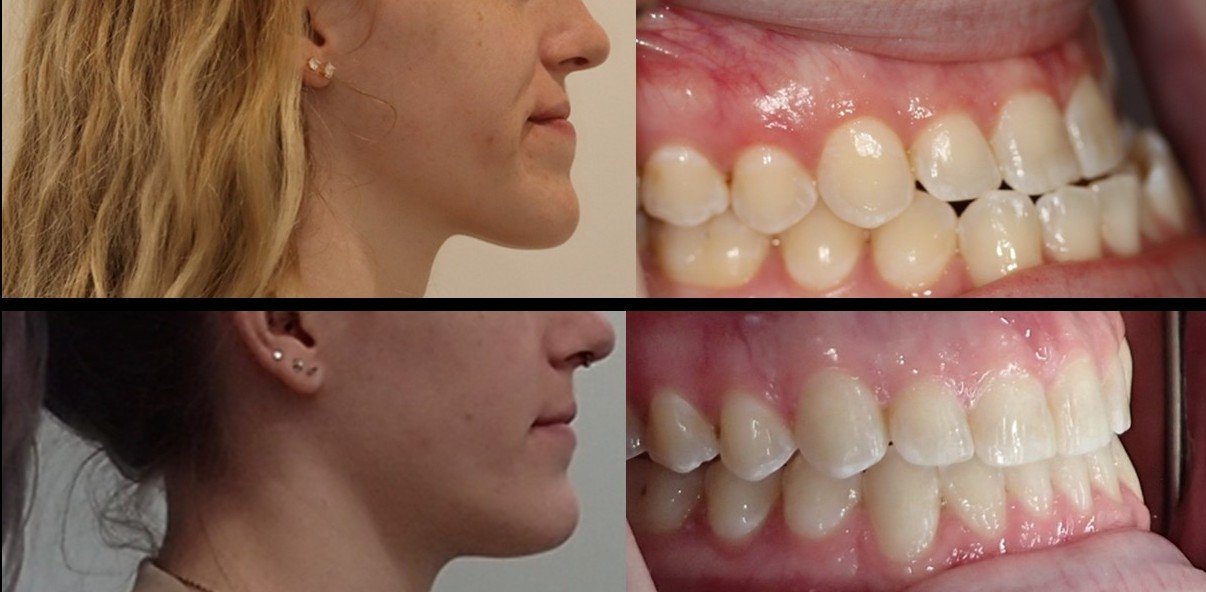
A patient came in with an underbite, an open bite, a posterior crossbite, and concerns about chin projection and how the bite functioned. The skeletal component meant orthognathic surgery was necessary. What is worth writing about is that the entire orthodontic phase, before and after surgery, was completed with clear aligners and no braces at any stage. Total treatment ran about two and a half years. This is not the default approach for surgical cases and it does not suit everyone, but it is no longer true that surgery automatically means braces.
ON THIS PAGE
What the patient presented with
Several things at once, which is common in skeletal cases. An underbite, meaning the lower teeth sat ahead of the upper ones rather than behind them. An open bite, where the front teeth did not meet even with the back teeth closed. A posterior crossbite, with upper back teeth sitting inside the lower ones. And dissatisfaction with chin projection and with how the bite functioned day to day.
Worth noting that last item, because it comes up less in case write-ups than it should. Function was part of the complaint. This was not purely about appearance, and in skeletal cases it rarely is. An open bite means you cannot bite through food with your front teeth, which sounds minor until you have lived with it.
Why surgery was necessary
This is the distinction that matters most and the one patients find least intuitive. Orthodontics moves teeth through bone. It does not move bone. When the underlying jaws sit in different positions relative to each other, teeth can be tipped to compensate, and for mild discrepancies that works well and nobody needs surgery.
Past a certain threshold, camouflage stops being a good idea. You end up tipping teeth beyond where the bone comfortably supports them, which risks the roots and the gums, and the result tends to be less stable. In a growing child we can sometimes influence how the jaws develop. In an adult that window has closed.
So in a genuinely skeletal case, orthognathic surgery coordinated with an oral surgeon is not the aggressive option. It is often the conservative one, because the alternative is asking the teeth to hide a problem they were never going to hide well.
If an office tells you surgery is required, ask to see the measurements behind that. And if an office promises to fix a large skeletal discrepancy without surgery, ask what the plan is for the roots. Both questions are fair and both have real answers.
Why aligners instead of braces
For a long time the assumption in orthodontics was that surgical cases needed fixed appliances, partly because surgeons often use the archwire as something to stabilize against, and partly because these cases demand precise control and braces were the reliable way to get it.
Aligner systems and the planning software behind them have improved enough that this is no longer a rule. Attachments, planned staging, and the ability to model the surgical movement digitally mean a well-selected case can run through the whole sequence in trays. This one did, from the pre-surgical phase through the finish.
I want to be measured about what that proves. It does not mean aligners are better than braces for surgical cases, and I would not present it that way. It means the option exists in selected cases, planned carefully, with a patient who wears the trays. Most people say Invisalign generically, but that is one brand of clear aligner. We also use Angel Aligners.
How a surgical case is sequenced
| Phase | What happens |
|---|---|
| Records and planning | Imaging and measurement establish whether the problem is skeletal, dental, or both. The orthodontist and oral surgeon plan the target together before anything starts. |
| Pre-surgical orthodontics | Teeth are positioned within each jaw so the two arches will fit once the jaws are moved. Counterintuitively the bite can look worse during this phase, because compensations are being removed. |
| Surgery | The oral surgeon repositions one or both jaws to the planned relationship. |
| Post-surgical finishing | The bite is detailed and settled into its final position. This phase is easy to underestimate and it determines how good the result actually is. |
| Retention | Permanent, as with any orthodontic case. Teeth move for life regardless of how they got where they are. |
The phase people are least prepared for is the second one. Being told partway through that the bite looking worse is exactly what should be happening is much easier to accept when someone explained it at the start.
Who this approach suits, and who it does not
Aligner-only surgical treatment depends heavily on compliance. Trays sitting in a drawer do nothing, and in a case with this many moving parts and a surgical date to plan around, inconsistent wear is more costly than it would be in a routine case. If someone tells me honestly that they will struggle to wear trays 22 hours a day, braces are the better recommendation and I will say so.
It also depends on the specific movements required. Some are more predictable in trays than others, and that assessment comes from records rather than preference.
And the far more common situation is that surgery is not needed at all. Most adult cases, including plenty that look severe in the mirror, are handled with orthodontics alone. If you are worried about this, get records taken before you spend months worrying about a surgery you may not need.
Braces move teeth. Surgery moves jaws. Getting the diagnosis right about which problem you actually have matters far more than which appliance is used to treat it.
Frequently asked questions
Can jaw surgery cases really be done with aligners instead of braces?
In selected cases, yes. This one was. It is not the default and it is not right for everyone, but the old assumption that surgical cases always require braces is no longer accurate. The deciding factors are the specific movements needed and whether the patient will wear the trays.
Why is jaw surgery needed at all if orthodontics can move teeth?
Because teeth and jaws are different problems. Orthodontics moves teeth within the bone. It cannot move the bone itself. When the upper and lower jaws sit in genuinely different positions, moving teeth can only camouflage that so far, and past a certain point camouflage creates its own problems.
How long does surgical orthodontic treatment take?
This case ran about two and a half years total. That is typical for surgical cases: alignment before surgery, the surgery itself, then finishing afterward. Non-surgical adult cases are usually much shorter, in the twelve to thirty month range.
Is treatment paused during and after surgery?
No. The orthodontic phase continues throughout. There is a short recovery window immediately after surgery, then the finishing phase begins, and that phase matters as much as anything that came before it.
What is a posterior crossbite and why does it matter?
It means the upper back teeth sit inside the lower ones rather than outside, which is backwards from how a bite should work. It affects chewing efficiency and loads teeth in directions they are not built for. Left alone it tends to cause uneven wear over time.
How do I know whether I need surgery or just orthodontics?
Records answer this, not an opinion at a glance. Photos, x-rays including a cephalometric view, and a scan let us measure the skeletal relationship rather than guess at it. Many people who assume they need surgery do not, and a few who assume they do not, do.
Wondering whether your bite is skeletal or dental?
Records answer it properly, and the consultation is free. Two Frisco offices plus The Colony.
You may also be interested in these
- Adult Braces in Frisco: Costs, Insurance, and Timelines
- What Is an Open Bite and How Can It Be Fixed?
- What Is a Crossbite and How Can It Be Fixed?
Why families trust Elate Orthodontics
1,000+ five-star reviews • 3 offices (two in Frisco, one in The Colony) • D Magazine Best Dentist 2026 • Living Magazine Readers’ Choice 2026
With over 1,000 five-star reviews across three locations, Elate Orthodontics is led by Dr. Kevin Baharvand, DMD, MS, a Diplomate of the American Board of Orthodontics, whose clinical work was recently selected for the cover of the American Journal of Orthodontics and Dentofacial Orthopedics, the most prestigious peer-reviewed journal in the field, and a national speaker on clear aligner treatment. Alongside Dr. Julia Kang, DMD, MS, both Boston University graduates and members of the Omicron Kappa Upsilon national honor society, our husband-and-wife team has been recognized as D Magazine Best Dentist 2026, Living Magazine Readers’ Choice 2026 Best Orthodontist in Frisco & Plano, Readers’ Choice Best Orthodontist in The Colony, Best New Business by the Chamber of Commerce, Nextdoor Neighborhood Favorite, and featured in Orthotown and Authority Magazine.
We serve families through three convenient offices in West Frisco, North Frisco, and The Colony, each staffed by the same trusted team, equipped with advanced technology, and committed to the personalized approach that consistently helps patients finish treatment sooner than expected. From braces and clear braces to Angel Aligners, we offer treatment for every age and every stage of life. We stay in-network with most insurance plans and offer flexible financing to make exceptional orthodontic care accessible for every family we serve.
Need general and family dentistry too? Our sister practice, Tribute Family Dentistry, provides dental care for all ages.
Book a free consultation: 972.538.4343
About the author
Dr. Kevin Baharvand, DMD, MS, is a Diplomate of the American Board of Orthodontics and a national speaker on clear aligner treatment. He practices at Elate Orthodontics in West Frisco, North Frisco, and The Colony, Texas.