

6 min read · By Dr. Kevin Baharvand, Diplomate, American Board of Orthodontics
Short answer: In a healthy bite, your upper front teeth slightly overlap the lowers, your back teeth mesh together evenly, your midlines line up, and everything is spaced without crowding or gaps. And at rest, your teeth should be slightly apart, not touching, with your lips closed and your tongue on the roof of your mouth. Small deviations are common and often fine. Bigger ones are worth checking.
On this page
People are often surprised that there’s a right answer to this. Teeth aren’t just supposed to be white and roughly straight. They’re meant to fit together in a specific way that lets your mouth do its job without wearing itself down. Here’s what “correct” actually looks like, and how to tell if yours are close.
What a healthy bite looks like
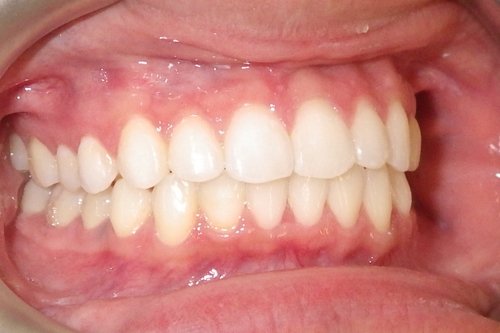
A well-aligned bite, what we call good occlusion, has a few consistent features. The upper front teeth overlap the lower front teeth just slightly, by a couple of millimeters, not covering them completely and not the other way around. The back molars fit together cusp-into-groove, like gears meshing. The midline between your two upper front teeth lines up with the midline between the lower two. And the teeth sit in a smooth arch with no crowding and no gaps. When you bite down, contact feels even across the whole mouth rather than slamming into one tooth first.
Where teeth should sit at rest
This is the part almost nobody knows, and it matters. When your mouth is relaxed and closed, your teeth should not be touching. The healthy resting posture is lips gently together, teeth slightly apart, and tongue resting up against the palate, with easy nasal breathing. Your teeth are only meant to come together briefly, when you chew or swallow.
If you catch yourself resting with your teeth clenched, or with your lips apart and mouth open, those are signals worth noting. Persistent clenching wears enamel and strains the jaw, and a habitually open mouth often points to a breathing issue. Tongue posture ties in here too, which is part of why something like a tongue tie can quietly affect how everything develops.
Common ways teeth don’t sit right
Most bites aren’t textbook perfect, and that’s normal. The common deviations each have a name, and we have full guides on the ones people ask about most. An overbite or overjet is when the front teeth overlap too much or stick out. A crossbite is when some upper teeth bite inside the lowers. An open bite means the front teeth don’t touch at all. Then there’s crowding when there isn’t enough room, and gaps when there’s too much. An underbite is when the lower teeth sit in front of the uppers.
Healthy vs off, at a glance
| Feature | Healthy | Off |
|---|---|---|
| Front overlap | Uppers slightly over lowers | Too deep, sticking out, or reversed |
| Back teeth | Mesh evenly cusp to groove | Crossbite or don’t meet |
| Spacing | Even, no crowding or gaps | Crowded or gapped |
| Midlines | Upper and lower line up | Shifted off-center |
| At rest | Teeth apart, lips closed, tongue up | Clenched, or lips apart and mouth open |
A quick self-check: bite down gently and notice where your teeth touch first. If one tooth or one side clearly hits before the rest, your bite is loading unevenly. That’s the kind of thing worth mentioning at an exam, even if nothing hurts yet.
Why it matters beyond looks
Straight teeth photograph well, but that’s the least interesting reason to care. A bite that sits correctly spreads the force of chewing evenly, which protects your teeth from grinding down in the wrong spots and spares your jaw joints from strain. Well-aligned teeth are also far easier to brush and floss, which lowers your risk of cavities and gum disease over a lifetime. When teeth don’t sit right, the damage tends to be slow and quiet, showing up years later as worn edges, a sore jaw, or a stubborn cavity in a crowded corner.
The good news is that how teeth sit is very fixable. Braces and clear aligners reposition the teeth and adjust how the arches meet, and in kids we can guide the jaws while they’re still growing. Whether a small deviation needs treatment or just monitoring is exactly the kind of call an orthodontist can make with you.
Frequently asked questions
How are teeth supposed to sit in a healthy bite?
In a healthy bite, the upper front teeth slightly overlap the lower ones, the back teeth mesh together evenly like gears, the upper and lower midlines line up, and the teeth are evenly spaced without crowding or gaps. When you bite down, the pressure feels even across your teeth rather than hitting one spot first.
Should my teeth touch when my mouth is at rest?
No. At rest, your lips should close gently, your teeth should be slightly apart, and your tongue should rest against the roof of your mouth. Teeth are only meant to touch briefly when you swallow or chew. If you notice your teeth clenched together at rest, that can contribute to wear and jaw strain.
How do I know if my bite is misaligned?
Common signs include front teeth that overlap too much or not at all, upper teeth biting inside the lower ones, teeth that do not meet in front, crowding, noticeable gaps, or uneven wear. Jaw soreness, difficulty chewing, and teeth that hit one side first are also clues. An orthodontist can confirm with an exam.
Does a slightly off bite really need to be fixed?
Not always. A minor, stable deviation that causes no wear, pain, or cleaning trouble can simply be monitored. Fixing a bite matters most when it causes uneven tooth wear, jaw strain, gum trauma, or makes teeth hard to keep clean. An orthodontist helps you tell the difference.
How do orthodontists correct how teeth sit?
Braces and clear aligners move teeth into proper position and adjust how the arches meet. In growing children, we can also guide jaw development, and a palate expander can widen a narrow upper jaw. The right approach depends on whether the issue is with the teeth, the jaws, or both.
Why does the way my teeth sit matter beyond appearance?
A well-aligned bite spreads chewing forces evenly, which protects your teeth from uneven wear and your jaw joints from strain. Straight, properly spaced teeth are also easier to keep clean, lowering your risk of decay and gum disease. So it is about function and long-term health, not just looks.
Not sure your bite is sitting right?
A quick exam and a set of records will tell you exactly how your teeth are meeting and whether anything needs attention. The consultation is free, and there’s no pressure to start.
You may also be interested in these
- What Is an Overbite and How Is It Different From an Overjet?
- What Is a Crossbite and How Can It Be Fixed?
- What Is Teeth Crowding and How Can It Be Fixed?
Why families trust Elate Orthodontics
With over 1,000 five-star reviews across three locations, Elate Orthodontics is led by Dr. Kevin Baharvand, DMD, MS, a Diplomate of the American Board of Orthodontics, whose clinical work was recently selected for the cover of the American Journal of Orthodontics and Dentofacial Orthopedics, the most prestigious peer-reviewed journal in the field, and a national speaker on clear aligner treatment. Alongside Dr. Julia Kang, DMD, MS, both Boston University graduates and members of the Omicron Kappa Upsilon national honor society, our husband-and-wife team has been recognized as D Magazine Best Dentist 2026, Living Magazine Readers’ Choice 2026 Best Orthodontist in Frisco & Plano, Readers’ Choice Best Orthodontist in The Colony, Best New Business by the Chamber of Commerce, Nextdoor Neighborhood Favorite, and featured in Orthotown and Authority Magazine.
We serve families through three convenient offices in West Frisco, North Frisco, and The Colony, each staffed by the same trusted team, equipped with advanced technology, and committed to the personalized approach that consistently helps patients finish treatment sooner than expected. From braces and clear braces to Angel Aligners, we offer treatment for every age and every stage of life. We stay in-network with most insurance plans and offer flexible financing to make exceptional orthodontic care accessible for every family we serve.
Need general and family dentistry too? Our sister practice, Tribute Family Dentistry, provides dental care for all ages.
Book a free consultation: 972.538.4343
About the author
Dr. Kevin Baharvand, DMD, MS, is a Diplomate of the American Board of Orthodontics and a national speaker on clear aligner treatment. He practices at Elate Orthodontics’ offices in West Frisco, North Frisco, and The Colony, Texas.