


6 min read · By Dr. Kevin Baharvand, Diplomate, American Board of Orthodontics
Short answer: A tongue tie is a short or tight band of tissue under the tongue that limits how far the tongue can move. Because the tongue helps shape the palate and guide jaw growth, a restrictive tie can contribute to a narrow arch, crowding, an open bite, or a crossbite. Fixing it usually means a simple release, tongue exercises, and orthodontics for the teeth that have already shifted.
On this page
Most people never think about their tongue until something goes wrong with it. But if you have crowded teeth, a narrow palate, or front teeth that never quite meet, the tongue is often part of the story. And sometimes the reason it can’t do its job is a tongue tie.
What a tongue tie actually is
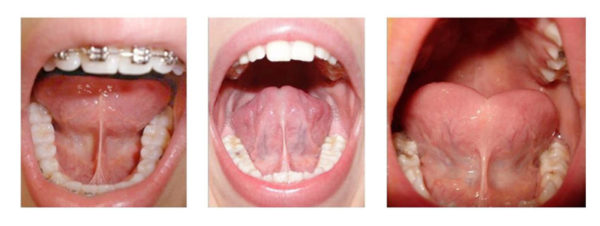
Under your tongue there’s a thin band of tissue called the lingual frenulum. It connects the underside of the tongue to the floor of the mouth. In some people that band is short, thick, or attached too close to the tip. When it restricts how far the tongue can lift or reach, we call it a tongue tie. The clinical name is ankyloglossia.
There are two general types. An anterior tie sits near the front and is usually easy to spot. The classic sign is a tongue that looks heart-shaped when a child tries to stick it out, because the tip stays tethered while the sides push forward. A posterior tie sits further back and hides under the surface, so it gets missed a lot more often. Someone can have real restriction without the obvious heart-shaped tip, which is why a posterior tie is easy to overlook.
Why the tongue shapes your bite
Here’s the part that surprises people. Your tongue is one of the main forces shaping the roof of your mouth. When it rests up against the palate, it works like a gentle mold, encouraging the upper jaw to grow wide and round. That’s the shape teeth are supposed to fit into. A tongue that can’t lift to the palate tends to sit low instead, resting against or between the teeth. Hour after hour, year after year, that changes how the jaws grow.
On paper, we tend to blame crooked teeth on genetics or a childhood thumb habit. In practice, tongue posture is doing quiet work every hour of the day, and a tie can throw that off before a single adult tooth even erupts. That’s why an orthodontic exam looks at where the tongue rests, not just at the teeth themselves.
Bite problems linked to a tongue tie
A tie doesn’t cause one specific problem. It nudges growth in a direction, and the result depends on the person. These are the patterns we see most:
| Bite issue | How a tongue tie contributes |
|---|---|
| Narrow arch / high palate | A low-resting tongue removes the outward pressure the upper jaw needs to widen, so the palate grows tall and narrow. |
| Crowding | A narrower jaw leaves less room, so teeth overlap and rotate as they come in. |
| Open bite | The tongue rests forward between the upper and lower teeth and slowly pushes them apart, so the front teeth never touch. |
| Crossbite | A narrow upper jaw doesn’t fit properly over the lower teeth, so some upper teeth bite inside the lower ones. |
| Spacing and gaps | Constant forward tongue pressure can splay teeth outward and open gaps, especially in front. |
If you want to go deeper on any of these, we have full guides on open bite and crossbite, both of which show up on this list.
Signs in kids and adults
In infants, a tie often shows up first as trouble with feeding. In older kids, the clues shift to speech and eating: difficulty with sounds like l, t, d, and r, a hard time licking an ice cream cone, or messy eating because the tongue can’t sweep food around the mouth. A mouth that’s usually open at rest is another one worth noticing.
Adults tend to describe it differently. Some can’t touch the roof of their mouth with the tongue tip. Others notice speech that gets tangled when they’re tired, tension in the jaw or neck, or snoring. None of these prove a tie on their own, and plenty of people have a minor restriction that never causes a problem. The signs matter when several of them line up.
The airway connection
A low tongue and an open mouth tend to travel together. When the tongue can’t reach the roof of the mouth, the mouth falls open to breathe, and mouth breathing has its own effects on facial growth and sleep. This is exactly why we look at breathing and tongue posture together instead of treating the teeth in isolation. Our airway-focused orthodontics exists for this reason, and you can read more about the mouth breathing we treat.
Worth knowing: Releasing a tie rarely fixes the bite by itself. The tie is the restriction. The bite problem is what years of altered posture and growth produced. Correcting the bite almost always needs orthodontics too.
How it is treated
Treatment usually has three parts, and skipping one is where results tend to fall short.
The release. A frenectomy or frenuloplasty frees the restrictive band. It’s a quick procedure, often done with a laser, by an ENT, an oral surgeon, or some general dentists. This restores movement, but movement alone isn’t the same as knowing where to put the tongue.
Myofunctional therapy. These are tongue and posture exercises that retrain the tongue to rest against the palate. Releasing a tie without retraining the tongue often gives incomplete results, because the muscle keeps doing what it always did. This step is easy to underestimate and genuinely matters.
Orthodontics. This is where the bite itself gets corrected. A palate expander can widen a narrow upper jaw, and braces or clear aligners close open bites and align crowded teeth. When aligners are the right tool, we prefer Angel Aligners over Invisalign for fit and finish, though Invisalign is the name most people know. Both are clear-aligner systems; Invisalign is simply the best-known brand in that category.
Timing helps. The American Association of Orthodontists recommends a first orthodontic evaluation by age seven, while the jaws are still growing and expansion is easiest. That doesn’t mean adults are out of luck. It just means correction leans more on orthodontics and less on guiding growth.
Think of the tongue as an orthodontic force. Give it room to work, retrain where it rests, then straighten what has already shifted. Skip a step and the correction tends to relapse.
Frequently asked questions
Does every tongue tie need to be treated?
No. Plenty of people have a mild tie and never notice a problem. We recommend treatment when the tie actually limits function, meaning it interferes with feeding, speech, breathing, or the way the jaws and teeth develop.
Can a tongue tie cause crooked teeth?
Not directly, but it can set the stage for them. By keeping the tongue low in the mouth, a tie removes the outward pressure the upper jaw needs to grow wide. A narrower jaw leaves less room, and teeth crowd or overlap as they come in.
At what age should a tongue tie be checked?
It can be evaluated at any age. Infants are often checked for feeding difficulty, and the American Association of Orthodontists recommends a first orthodontic visit by age seven, which is a good time to look at tongue posture and jaw growth together.
Will releasing a tongue tie straighten my teeth?
No. A release restores how far the tongue can move, but teeth that have already shifted need orthodontic treatment to move back into place. The release and the alignment are two different jobs.
Is the release procedure painful?
It is a quick procedure, usually done with local numbing or a laser. Most people are a little sore for a few days and back to normal eating soon after.
Do adults benefit from tongue tie treatment?
They can, especially when a release is paired with myofunctional therapy to retrain tongue posture. Since jaw growth is finished in adults, orthodontics does more of the correction, but improving tongue function still helps stability and comfort.
Not sure if a tongue tie is affecting your bite?
We look at the tongue, the airway, and the bite together, not one at a time. If something has felt off with speech, breathing, or crowding, a quick evaluation will tell you whether the tongue is part of the picture.
You may also be interested in these
- What Is an Open Bite and How Can It Be Fixed?
- What Is a Crossbite and How Can It Be Fixed?
- Mesiodens: Causes, Diagnosis, and Treatment of an Extra Front Tooth
Why families trust Elate Orthodontics
With over 1,000 five-star reviews across three locations, Elate Orthodontics is led by Dr. Kevin Baharvand, DMD, MS, a Diplomate of the American Board of Orthodontics, whose clinical work was recently selected for the cover of the American Journal of Orthodontics and Dentofacial Orthopedics, the most prestigious peer-reviewed journal in the field, and a national speaker on clear aligner treatment. Alongside Dr. Julia Kang, DMD, MS, both Boston University graduates and members of the Omicron Kappa Upsilon national honor society, our husband-and-wife team has been recognized as D Magazine Best Dentist 2026, Living Magazine Readers’ Choice 2026 Best Orthodontist in Frisco & Plano, Readers’ Choice Best Orthodontist in The Colony, Best New Business by the Chamber of Commerce, Nextdoor Neighborhood Favorite, and featured in Orthotown and Authority Magazine.
We serve families through three convenient offices in West Frisco, North Frisco, and The Colony, each staffed by the same trusted team, equipped with advanced technology, and committed to the personalized approach that consistently helps patients finish treatment sooner than expected. From braces and clear braces to Angel Aligners, we offer treatment for every age and every stage of life. We stay in-network with most insurance plans and offer flexible financing to make exceptional orthodontic care accessible for every family we serve.
Need general and family dentistry too? Our sister practice, Tribute Family Dentistry, provides dental care for all ages.
Book a free consultation: 972.538.4343
About the author
Dr. Kevin Baharvand, DMD, MS, is a Diplomate of the American Board of Orthodontics and a national speaker on clear aligner treatment. He practices at Elate Orthodontics’ offices in West Frisco, North Frisco, and The Colony, Texas.